
The Year 5 to 10 Ops Wall That Breaks Your P&C Agency
By Craig Pretzinger and Jason Feltman
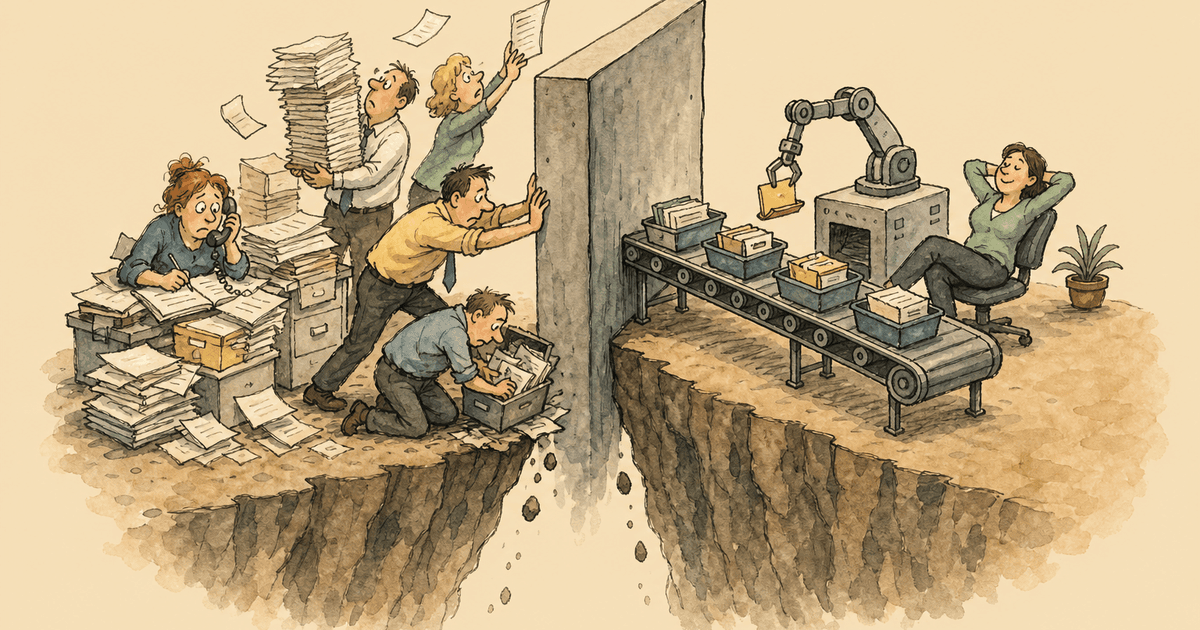
Hitting a wall around year five is the owner-as-top-producer system reaching its limit, not a people failure. Dropping a new hire into a broken, undocumented workflow just runs the same broken machine. The same gap shows up in succession, where only 25 percent of owners have a documented plan.
Why Do Your Agency Ops Start Breaking Around Year Six?
The operational wall agencies hit between year five and ten is a systems problem, not a people problem. Renewals pile up, service calls interrupt sales calls, and every new hire needs help of their own. Better people will not fix a book the system cannot carry.
You run the same diagnosis most owners run: wrong people. The Insurance Dudes have featured several operators who've run agencies past this wall. What shows up consistently isn't a personnel upgrade.
It's a structural reframe. Beau Vincent's episode on building a high-performance culture with 13,000 policies is direct: the gap agency owners hit at this stage is a leadership gap, not a talent gap. The team you have is running the system you built.
If the system is broken, they'll run it broken regardless of how capable they are individually. Sit with that before you post another job listing.
TL;DR
The wall agencies hit between year five and ten is not a people problem; it is the owner-as-top-producer system reaching its limit, and putting a new person into a broken, undocumented workflow just gives you a different personality running the same broken system. The same fragility shows up in succession: only 25 percent of agency owners are aware of a documented plan, because the operational knowledge lives in the owner's head, which slows the agency every time the owner takes a week off or steps back into service.
Start with a two-week time audit logging every task in 15-minute blocks, which maps everything that could be delegated but is not, then pick the single highest-volume owner-handled task and document it fully: trigger, steps, decision rules, output, and quality check. Hand that one process off with a two-week overlap and remove yourself as backstop, then repeat it twelve times to materially change what the agency depends on you for.
How Did You Build a Growth Ceiling Without Knowing It?
Kelly Donahue's episode covers a pattern she sees over and over: owners who operate primarily as top producers create growth ceilings. The production keeps revenue up. The revenue keeps pressure off.
And the process documentation, delegation framework, org structure never get built because there's no immediate pain forcing them. Then the book gets big enough that the owner-as-producer model stops covering the gaps. Service volume exceeds capacity.
Owner steps back into service to cover it. Production drops. Revenue pressure returns.
The cycle tightens. Jack Wingate names it plainly: the thing that got you here becomes the ceiling. The habits that produced the first 2,000 policies (handling the big accounts personally, being the institutional memory, being the decision point for anything complicated) are not a foundation for the next 5,000.
They're a cap on it. His prescription: a time audit before any other intervention. Two weeks logging every task in 15-minute blocks.
What you find isn't laziness. It's a map of everything that could be delegated but isn't, because there's no documented process, no clear ownership, no training for the person who would receive it.
Is Your CSR Really the Problem?
The frustration at this stage usually lands on service staff. They're closest to the friction, so they absorb the blame. Q4Intel's 3-pillar framework makes the structural point: agencies that free salespeople from service work by systematizing the service function grow faster with less friction.
The pillar isn't "hire better CSRs." It's build the service system so any competent CSR can operate it without you as backstop. One approach is a personnel decision. The other is a process decision.
Personnel decisions recur every time someone leaves. Process decisions compound. What most service staff are running at the year-six wall is an undocumented, owner-dependent, exception-heavy workflow that even a highly competent person would struggle with.
Put a different person in that seat and you get a different personality running the same broken system. Vincent's framework for reaching 13,000 policies involved building a genuinely self-sustaining service layer. Every repeatable task has a documented procedure, a clear owner, and a quality check that doesn't require the principal to be the quality check.
Why Is the Year-Six Wall Also a Succession Problem?
Vertafore's 2024 workplace report found only 25 percent of agency owners are aware of a documented succession plan. That reads like a retirement problem. It's also an operations problem.
An agency with no documented processes is an agency where the operational knowledge lives in the owner's head. That's not a succession risk in the abstract. It's a present-day fragility.
Every time you take a week off, get sick, or want to spend a day on production instead of service, the agency slows down because the systems live in you rather than the business. The year-five-to-ten wall and the succession gap are the same problem with different timelines. Same fix: get the processes out of your head and into documented, trainable, ownable systems.
Where Should You Start Fixing Your Agency's Systems?
The time audit Wingate describes is the right starting point because it doesn't require any decisions about what to change. Just honesty about where the hours go. From that audit, one category will jump out: tasks that are repeatable, currently owner-handled, and have no documented process.
That's your first delegation target. Pick the single highest-volume item. Document it completely: trigger, steps, decision rules, output, quality check.
Hand it off with a two-week overlap. Then remove yourself as backstop. That's one process that no longer runs through you.
Do it twelve times and you've materially changed what the agency depends on you for. The team you have may be entirely capable of running those processes. They've just never been given the process to run.