
DISC Will Not Tell You Who to Hire. It Tells You How
By Craig Pretzinger and Jason Feltman
Do not use DISC to decide who to hire; that creates EEOC exposure and predicts nothing. Its payoff is the day after the offer: a one-page profile read for 90 seconds before each conversation removes roughly 40 percent of the management friction that otherwise gets mislabeled a people problem.
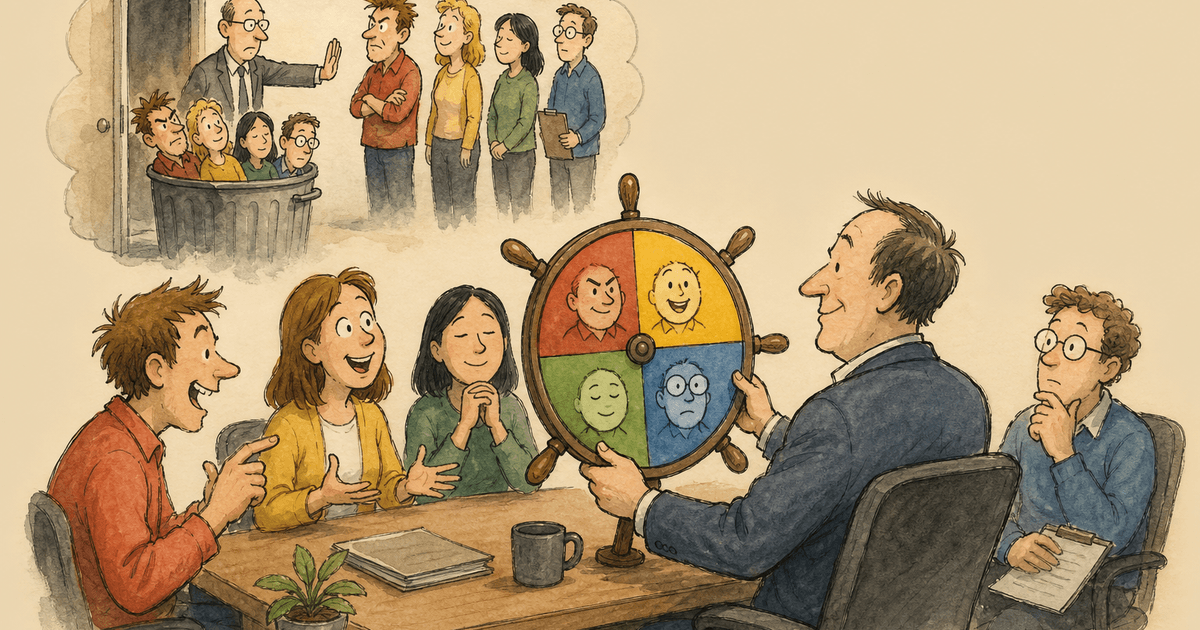
Why Is Your DISC Assessment Sitting in a Folder?
Most agency owners who've run DISC assessments on their team can describe the general profiles. High D producer, high S CSR, the C who needs every detail before making a move. Profiles get discussed at the team meeting, maybe referenced once, then filed.
Three months later nothing's changed. Same producer pushes back on structure.
Same CSR waits to be told what to do. Same feedback conversations feel like pushing against a heavy door.
The problem isn't the assessment. The problem is treating it as a hiring filter instead of a management tool.
The Insurance Dudes address this in their DISC mailbag post: DISC describes behavior, not performance. Using it to screen candidates in or out creates legal exposure under the EEOC guidance on employment tests and selection procedures and misses the actual value. The DISC framework documentation is explicit about EEOC compliance boundaries.
Hiring decisions require job-related criteria. Behavioral style isn't one. What DISC is built for is what happens after the hire.
TL;DR
DISC will not tell you who to hire, and using it as a hiring filter creates EEOC exposure while missing the entire value; its job starts after the hire, in how you manage the person. DISC measures behavior, not performance or values, and a one-page profile reviewed before one-on-ones removes roughly 40 percent of the management friction that otherwise shows up as a "people problem." It changes three concrete things: how you assign work (detail-forward for a high-C, context-forward for a high-I), how you deliver feedback (direct for a high-D, relational context first for a high-S), and how you structure accountability (public scoreboard for some, private benchmark for others). Keep a one-page profile per employee where you will actually see it, and spend 90 seconds on it before any feedback conversation or new assignment.
What Do the DISC Profiles Actually Tell You?
DISC measures four behavioral tendencies: Dominance, Influence, Steadiness, Conscientiousness. Not intelligence.
Not values. Not whether someone will produce.
The Insurance Dudes make the distinction plainly: values alignment outperforms personality type when predicting who stays and builds a career in your agency. A high-D with misaligned values will cause more friction than a high-S with strong values alignment, regardless of what the textbook says about "natural producers."
What the profile tells you is how someone processes information, handles urgency, responds to feedback, and structures their day. That's the raw material of every management conversation you'll have. Agents on r/InsuranceAgent who describe successful long-term team members consistently note that the relationship shifted when communication style adjusted to the person, not a generic management template.
Where Does DISC Change Your Day-to-Day?
Assigning work. A high-C given a vague directive ("handle the renewal book") will stall or ask for clarification repeatedly. Not a performance problem.
A behavioral style that needs specification. Same assignment given as "contact the 47 accounts renewing in October, use this checklist, flag any with a premium change over 15 percent" lands completely differently. No additional management required.
A high-I given that same granular instruction may push back or disengage. They need context and room.
The directive becomes: "Own October renewals. Here's the goal, here are the guardrails. Come to me if you hit something outside those."
Same outcome. Completely different path.
Giving feedback. A high-D receives direct feedback without softening. Hedged feedback reads as uncertain leadership.
A high-S needs relational context before the correction. Leading with the correction before acknowledging the relationship shuts the conversation down.
Kelly Donahue's Insurance Dudes episode makes the point: "Culture is the output of deliberate choices." Feedback is one of those choices. It doesn't have to be natural talent. It can be a repeatable formula adjusted to style.
Motivation and accountability. Seth Preus on the Insurance Dudes covers the gap between extrinsic motivation (leaderboards, competitions, public recognition) and intrinsic motivation (daily consistency, personal standards, quiet accumulation of wins). Some profiles run on external scoreboarding. Others find it exhausting and prefer a private benchmark.
A high-I producer on a team leaderboard will perform for the recognition. A high-C on the same leaderboard may disengage because public comparison is beside the point of how they measure themselves. Running one accountability structure for both leaves one underserved.
What Is the 90-Second DISC Formula?
Practical application: a one-page profile reference per employee, kept somewhere you actually look at it. Before weekly one-on-ones, before a performance conversation, before you drop a new responsibility on someone, spend 90 seconds on the profile. Three questions:
-
How does this person prefer to receive information? (Detail-forward or context-forward?)
-
What creates friction for them? (Ambiguity, urgency, public scrutiny, slow pace?)
-
What does accountability look like for them? (Public or private, metrics or milestones?)
That's not a psychology exercise. It's a prep habit that removes about 40 percent of management friction that would otherwise show up as a "people problem."
What Doesn't DISC Replace?
DISC doesn't replace clear expectations. Doesn't replace documented performance standards. Doesn't replace the direct conversation when someone is underperforming.
Donahue's framework on deliberate culture is relevant here: the behavioral data gives you the channel, not the message. You still have to decide the standards and hold people to them. The profile just tells you how to have the conversation in a way the other person can actually receive.
The assessment isn't magic. It's a description of how someone is wired. What you do with that description determines whether it ever leaves the folder.
Sources cited in this analysis?
- Insurance Dudes: DISC Profiles and Producer Hiring.
- Insurance Dudes: Seth Preus on Team Motivation and Accountability.
- Insurance Dudes: Kelly Donahue on Agency Culture.
Disclaimer: This post is for educational purposes and is not legal advice. Using assessments in employment decisions can carry EEOC and other legal exposure. Consult qualified employment counsel before applying any screening or hiring criteria.