
Why 69% of Your Team Is High-S and Why That Matters
By Craig Pretzinger and Jason Feltman
Hiring people like your best performers quietly builds an all-S team that runs smoothly and decides slowly. Insurance skews about 69 percent high-S, so a few high-D hires give you someone willing to force a stalled call. A balanced team turns three meetings into one decision and lifts rounding.
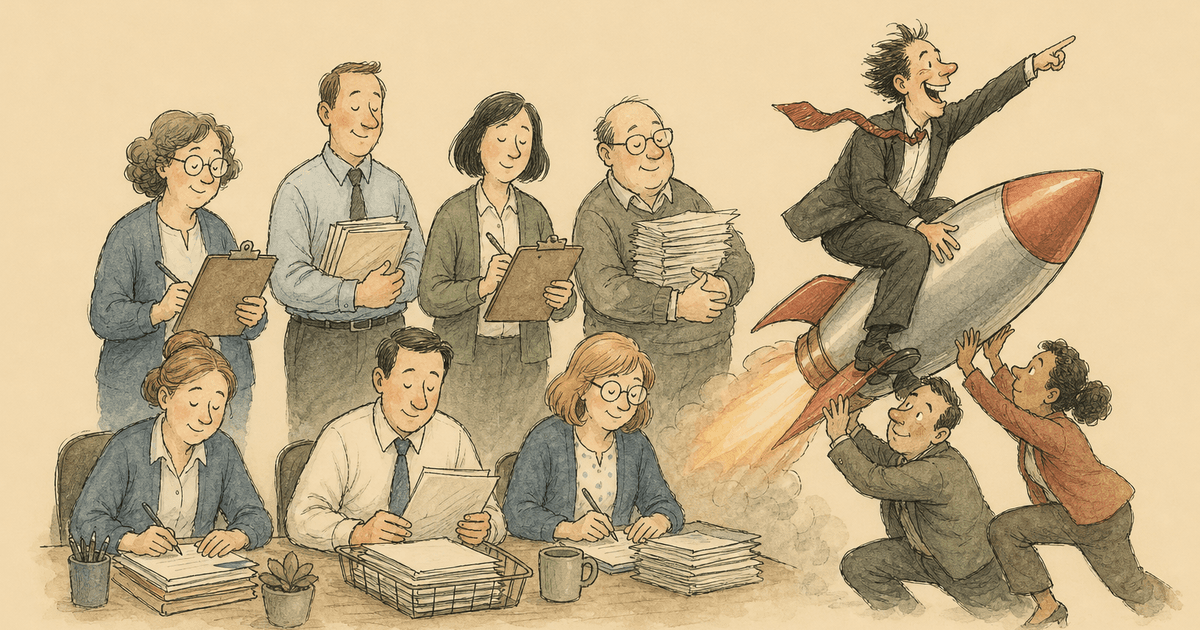
Why Is Your Agency Team 70 Percent the Same Profile?
A team of people who all think like you is slower than a balanced one. Insurance agencies skew heavily high-S: steady, process-driven, conflict-averse. That core is mostly a feature, but a team with zero high-D has no one built to push, challenge, and close.
That's not a problem. An agency without a strong high-S core has the turnover, inconsistency, and client service breakdowns that Cornell ILR research links together. The problem is what happens when the entire team is high-S and there's nobody in the room willing to challenge a decision, push a stalled deal forward, or tell a client something they don't want to hear.
TL;DR
Hiring to your own comfort builds a team of clones that is easy to manage and slow to grow, because roughly 69 percent of the insurance workforce is high-S and an all-S team has nobody wired to push a stalled decision. A team calibrated entirely for steadiness turns 10-minute decisions into three meetings and quietly resists new ideas, and it shows up on the dashboard as account rounding stuck below the 80 percent benchmark, since rounding needs someone willing to introduce a product the client did not ask for.
The fix is composition, not a personality overhaul: map every team member's DISC before the next hire, put high-D profiles in producer or hybrid roles rather than over a high-S team, and pair high-S account managers with a high-I or high-D producer who models the proactive conversation. Run DISC across your whole team this week, and if every score clusters in the S or C quadrant, you already know the gap to hire for before you write the job post.
What Do the Four DISC Profiles Actually Mean?
The DISC framework measures four behavioral tendencies: Dominance (D), Influence (I), Steadiness (S), and Conscientiousness (C). Not personality types that predict whether someone is good or bad. Just how someone naturally communicates, responds to problems, and operates under pressure.
High-D: direct, results-focused, comfortable with conflict. High-I: expressive, persuasive, relationship-first. High-S: patient, reliable, resistant to rapid change.
High-C: analytical, precise, quality-focused. Most agency owners are high-D or high-I. Most CSRs and account managers are high-S or high-C.
That's not accidental. The roles attract compatible profiles. The problem shows up when the entire team gets selected to match the owner's comfort level rather than to cover the behavioral gaps.
What Does an All-High-S Team Actually Do?
The Insurance Dudes' analysis puts it directly: "Teams filled entirely with high-D/I lack consistency." Flip it and it's just as true. Teams filled entirely with high-S lack urgency. Watch a team meeting where everyone is high-S or high-C.
Decisions that could take 10 minutes take three meetings. Nobody challenges consensus. The person with the most tenure has unspoken veto power because high-S profiles weight stability heavily.
A new idea that disrupts a comfortable process gets quiet resistance that nobody voices out loud. Not bad behavior. Just the natural output of a team calibrated for consistency instead of change.
But insurance agencies need both. Renewal retention requires high-S patience and thoroughness. Growth, cross-sell, new market development, and hard conversations with underperforming producers require high-D directness or high-I relational energy.
Why Do You Need a High-D Even When Consistency Wins?
Seth Preus's leaderboard research makes a counterintuitive point: top performers in insurance are defined by daily consistency, not occasional monster months. A producer who has one great month per quarter performs worse over five years than one who hits 80 percent of goal every single month. That reframes the D versus S question.
You don't need a high-D for dramatic results. You need one for forward motion on decisions that would otherwise stall in the comfort of the group. One high-D asking "why are we waiting on this?" in a meeting moves things more consistently than occasional bursts of urgency from people who aren't wired for it.
Beau Vincent's culture framework uses the framing "people development is the highest-leverage work." Applied to team composition: you can't develop people if the team is so homogeneous that developmental friction disappears. A high-D on a team of high-Ss creates productive tension that surfaces problems before they compound.
What Does a Balanced Team Show on the Dashboard?
Kelly Donahue's systems work focuses on operational outcomes. Agencies with strong service capacity but weak proactive outreach show account rounding rates well below the 80 percent benchmark. Account rounding needs a service person (high-S strength) who is also willing to introduce a product the client didn't ask about (high-D or high-I strength).
An all-S team does the service half great and skips the second half consistently. Not from laziness. From behavioral profile.
The agencies hitting 80 percent or above on account rounding are the ones where at least some service staff have been paired with a high-D or high-I colleague who models the proactive conversation. Or they've got at least one producer in a semi-service hybrid role who sets the norm.
Which 5 Plays Build a Balanced DISC Team?
1. Map your team before your next hire. Run DISC on everyone. Look at the distribution.
If every score clusters in the S or C quadrant, you already know what you're missing before you post the job. 2. Don't hire a high-D to manage high-Ss. The behavioral mismatch in management creates friction without payoff.
A high-D managing a high-S team will push too hard, too fast. Put high-D profiles in producer or hybrid roles where the directness is an asset. **3.
Pair high-S account managers with a high-I or high-D producer on the same accounts.** The proactive conversation gets initiated by the person wired for it, and the service depth stays intact. Structure play, not personnel play. **4.
Watch how the team handles a client escalation.** High-S teams de-escalate by avoiding the hard conversation. High-D teams escalate too fast. The goal is enough range to choose the right approach, not default to the comfortable one.
5. Use DISC for management, not filtering. The Insurance Dudes are explicit: DISC describes behavior, not performance. A high-S can be a great producer.
A high-D can be a terrible one. Use the profile to understand communication style. Use production data to make performance decisions.
A team of clones is comfortable to manage. It's also slow to grow. Behavioral range produces outcomes that homogeneity can't.