
Offshore Dialer Cost Math: Callers for a Dime a Dial
By Craig Pretzinger and Jason Feltman
An overseas caller on a power dialer costs roughly ten cents per dial, while a US caller at the same volume costs about thirty two cents. That three times gap widens to sixteen when manual dialing caps output. The offshore model is a math unlock, not a wage cut.
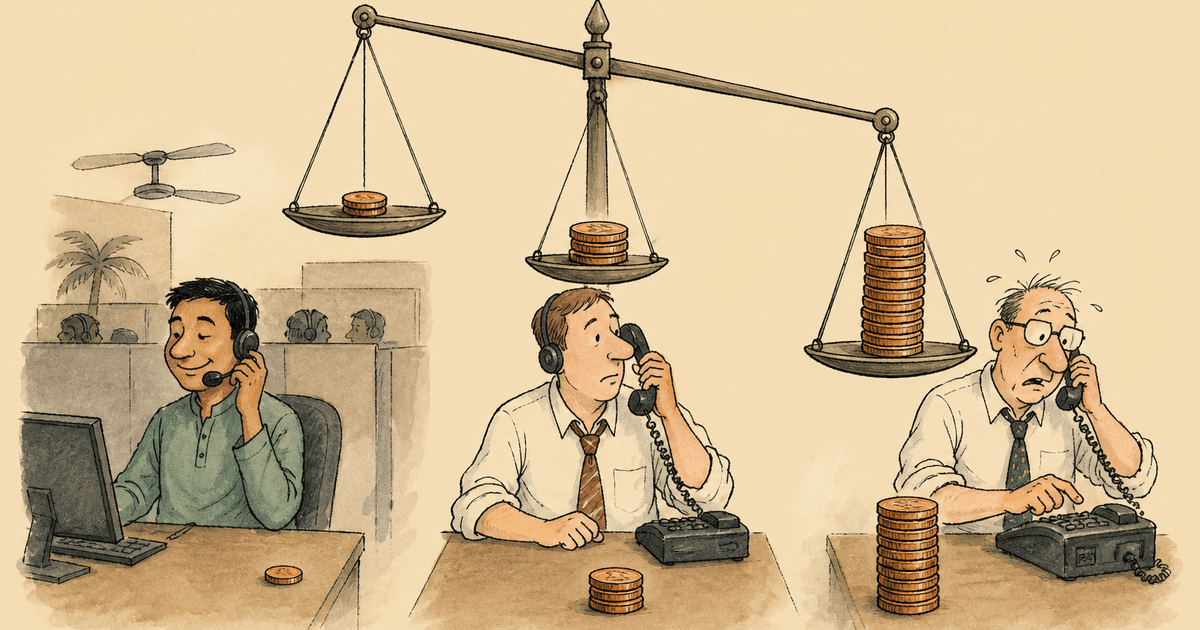
An overseas caller on a power dialer costs about ten cents a dial. A US caller working the same 500 dials costs about thirty two cents. That three times gap is the whole reason the offshore model works, and it only widens from there.
TL;DR
Offshore dialing is a labor-cost math play, not a wage cut for its own sake. A caller in the Philippines or Colombia runs $4 to $8 an hour fully loaded, and a US caller runs $18 to $25. At 500 dials a day, that is $48 against $160 for the same output, a three times gap translated straight to per-dial cost.
Manual dialing makes it worse. A US closer hand-dialing a list tops out near 100 calls a day, so the real per-dial spread is sixteen times. The offshore model only unlocks behind a power dialer and a role split where callers call and closers close.
Key Takeaways
- Offshore callers cost $4 to $8 an hour fully loaded, against $18 to $25 for US dialers.
- The per-dial math is a dime against thirty two cents, a three times labor gap.
- Manual dialing caps a US caller near 100 calls, widening the real spread to sixteen times.
- The model only works with a power dialer and a strict caller-versus-closer role split.
- Pay the caller on dials and transfers, never on premium, or the cost savings leak away.
Why does the offshore dial math hold up for an agency owner?
Because the inputs do not move. A power dialer lets a caller place one call every 57 seconds, and 500 dials in an eight hour shift is the floor, not the ceiling. The labor that runs those dials is the only lever you control.
O*NET frames the US baseline clearly. Insurance sales agents carry a median wage around $60,370 a year, which is roughly $23.96 an hour before you add payroll tax, benefits, and a phone system. Loaded, a US caller runs $18 to $25 an hour, and often more in a metro market.
An offshore caller in the Philippines, Colombia, or South Africa runs $4 to $8 an hour fully loaded. That is the labor-arbitrage gap that underpins the whole Telefunnel model, the first-party framework behind the TeleDudes offshore dialing system.
So the question is not whether offshore is cheaper. It is whether the math holds once you price the dials.
What is the per dial cost of a caller?
Take the 500 dial floor from our TeleTeam dial math breakdown. An offshore caller at $6 an hour works eight hours for $48, and at 500 dials that is $48 divided by 500, roughly $0.096 a dial. Call it a dime.
A US caller at $20 an hour works the same eight hours for $160. At 500 dials, that is $0.32 a dial. The gap is three times, on the same headset, the same list, and the same script.
Then the real cost shows up. Manual dialing caps a US caller near 100 calls a day, because a human can only click, wait, and talk so fast. At 100 dials, that same $160 buys $1.60 per dial, sixteen times the offshore dime. The savings are not a rounding error. They are the entire unit economics.
"I pay a caller thirty five an hour to leave voicemails, then I stare at the lead bill like I got robbed. The phone was never the problem. The wage was."
That is how most owners say it. The instinct is right, and it is aimed at the wrong column.
Why do top agencies split dialing from closing at all?
Because a closer hand-dialing is the most expensive phone work in the building. The Big I and Reagan Consulting Best Practices Study has benchmarked top agencies for over thirty years, and the highest performers share one structural trait: role separation. Callers call, closers close, service reps service.
The Best Practices gateway at the Big I makes the same case for productivity, where every role runs at its own cost level. The agencies that split labor this way out-produce the ones where one licensed producer carries the whole phone.
When a US closer spends three hours dialing between quotes, you are paying $35 an hour for $6 an hour work, and the closer is not closing during that window. The offshore split fixes that by design. This is the same cost-level logic we walk through in our caller KPI dashboard post.
How do you price the labor without leaking the savings?
Pay the caller on the inputs they control, not the premium they cannot. Cornell's ILR School frames performance-based pay as a function of measurable inputs, and that is exactly how a caller should be structured.
A caller gets paid on dials completed and warm transfers logged. The closer gets paid on quotes and binds. If you dangle commission at the caller, you have built two closers and one of them cannot close, and the five percent of premium you hand them eats the sixteen times savings you built.
The offshore dime only stays a dime if the caller is managed as an input machine. Track dials, contact rate, and transfers on the dashboard, and let the numbers in our aged lead economics post remind you that cheap labor does not rescue cheap data.
Sources cited in this analysis?
- O*NET OnLine, Insurance Sales Agents Occupational Summary -- US wage baseline for insurance sales agents (median near $60,370).
- Insurance Information Institute, Facts and Statistics: Careers and Employment -- 2.98 million industry jobs and agency employment scale.
- Reagan Consulting, Best Practices Study -- 30 plus year benchmark of top agency productivity and role separation.
- Big I, Best Practices Study -- productivity and operational benchmarks for independent agencies.
- SHRM, Key Components of Performance Management -- input-driven performance measurement and feedback cycles.
- Cornell ILR School, Compensation Glossary of Terms -- performance-based pay tied to controllable inputs.
- The Insurance Dudes Files, blog hub -- first-party Telefunnel and TeleDudes offshore dialing framework.
Frequently Asked Questions
Is outsourcing dialers just paying a lower wage for the same work?
Not the same work. An offshore caller is dial-and-transfer only, unlicensed and low-scope, while a US closer quotes and binds policy. The wage gap reflects real role separation, not a discount applied to identical labor being done faster by a cheaper person.
Can offshore callers work without a US insurance license?
No. In most states an unlicensed caller can dial leads and warm-transfer them to a licensed closer, as long as they do not quote, bind, or discuss coverage specifics. Keep the caller away from the policy conversation entirely and the model stays compliant.
How many dials make the offshore savings actually materialize?
Five hundred a day is the floor. Below that, the $4 to $8 hourly rate still looks fine, but the per dial math never compresses, and you are paying idle time instead of bought output. Volume is what turns a cheap wage into a cheap dial.
What is the hidden cost that eats offshore savings?
Paying the caller on premium. Commission handed to a dialer erases the sixteen times gap faster than any other mistake, because you have silently converted a low-cost input role into a second closer that cannot actually close or quote the business you need.