
The Commission Split Quietly Killing Your Agency Growth
By Craig Pretzinger and Jason Feltman
Paying a high commission split to attract producers funds your own flat growth; the split that works ties to production, not attendance. MarshBerry ties formal production accountability to 50 percent higher organic growth, while turnover runs 16.4 percent no matter the pay. Start new-business splits near 30 percent.
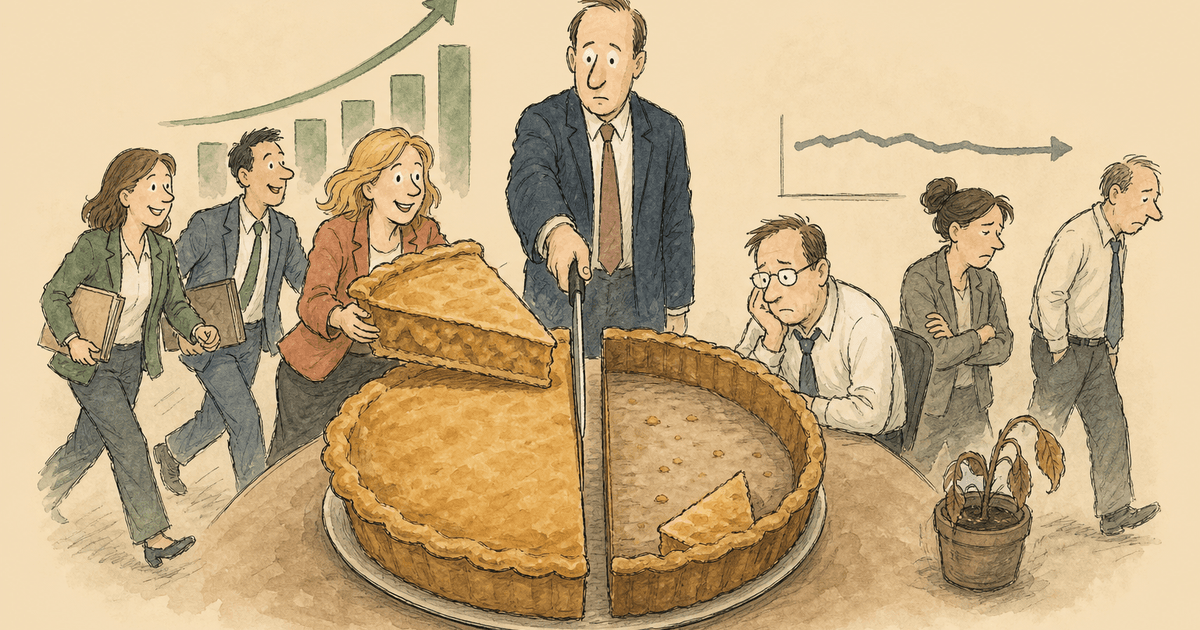
What Does Month 14 With a Non-Producing Producer Cost You?
A high commission split that rewards showing up loses to a structured plan that rewards production. Pay a 40 percent split with no production requirement and you fund draws, E&O, and empty pipelines while growth stalls. The split is not the magnet you think it is.
MarshBerry's compensation study shows insurance industry turnover running at 16.4 percent. Nearly one in six people on your team will leave this year regardless of what you pay.
The agencies that break this cycle aren't the ones paying the highest splits. They're the ones paying splits tied to something.
TL;DR
Paying a high commission split to attract producers is how agencies fund their own flat growth; the split that works is tied to production, not to showing up. MarshBerry found agencies with formal production accountability post 50 percent higher organic growth, while industry turnover runs 16.4 percent regardless of how generously you pay. New-business splits should start at 30 to 33 percent and rise only when production crosses a threshold, typically a book that validates near $96K by year three, with a recoverable draw and tracked activity standards in between.
Skipping milestones for an experienced hire is the costliest version, because poor year-one performance is the single strongest predictor of non-performance at year three, and experience does not change that pattern. Put production milestones on the table before you name a split, so the number is the last thing discussed, not the first.
What Does Market Rate for a New Producer Actually Mean?
The number most owners hear isn't what they think. MarshBerry's data puts new producer commission splits in the 30 to 33 percent range on business written. Service staff comp runs about 5.8 percent of revenue.
Those aren't ceilings. They're starting points on a production-linked ladder. Agency Consulting Group's framework shows the standard progression: new producer earns 30 to 33 percent in year one, with that percentage increasing as the book grows and validates.
The split doesn't go up because time passed. It goes up because production hit a threshold. That distinction is the entire difference between a comp plan that carries dead weight and one that pushes producers forward.
Why Does Raising the Base Split Push You Toward the Payroll Ceiling?
MarshBerry's talent research puts total payroll at roughly 70 percent of revenue across the industry. And 75 percent of agency owners raised comp in the last 12 months. Not because they felt generous.
Because the market forced it. When you raise the base split to compete on paper rather than compete on structure, you creep toward that 70 percent ceiling without adding production to justify it. The agency starts feeling heavy.
Less room to breathe when a renewal comes in soft or a carrier pulls a market. The agencies staying below the ceiling are the ones where every compensation dollar is attached to an activity or outcome.
Why Does a Split Without a Production Requirement Create Non-Producing Producers?
MarshBerry's research on non-producing producers drops a hard number: agencies with formal production accountability show 50 percent higher growth than those without. The $96,000 year-three benchmark they cite isn't arbitrary. That's the point where a producer's book is big enough that the math starts working in the agency's favor.
Below that number, the agency is subsidizing someone's training. Above it, the relationship becomes genuinely mutual. Your comp structure should reflect which side of that line a producer is on.
When a high split gets offered upfront without a production requirement, there's no structural pressure to cross the line. Some producers do it anyway because they're wired that way. The ones who aren't have no external reason to push.
What Does a Structured Producer Comp Plan Actually Look Like?
The formula that shows up consistently across Agency Consulting Group and the Insurance Dudes' 5-step system follows this progression: Year 1: Base draw plus 30 to 33 percent of new commission written. Activity standards required (calls, quotes, closes tracked weekly). Draw is recoverable against future commissions.
Year 2: Draw phases down. Split moves to 33 to 36 percent if year-one production hit the minimum threshold (typically $40K to $50K in new commission). If threshold missed, terms get renegotiated or the relationship ends.
Year 3: Full producer split at 36 to 40 percent once the book validates at or above $96K. At that point the book itself is an asset that partially justifies the higher split even in a slow year.
The exact percentages are negotiable. The structure is not. Without thresholds, the plan is just a salary with extra steps.
Why Is Skipping Milestones for an Experienced Hire a Costly Mistake?
The most common version: owner recruits someone with 10 years of experience, offers a generous split to avoid losing them, and skips the milestones because "it feels insulting to someone with that background." MarshBerry's data on experienced producers is clear: poor performance in year one is the single strongest predictor of non-performance at year three. Experience doesn't change that pattern. The agencies that skip milestones because a hire is experienced are the ones carrying the most dead weight.
The structured plan isn't a punishment. It's a shared map.
A producer who's genuinely going to perform has no reason to resist it. And if they do resist it, that resistance tells you something important before you're 14 months in.
Where Does the Commission Split Conversation Go Wrong?
Most comp negotiations happen in the wrong order. The owner names a split to attract the candidate, then tries to attach accountability after the offer is accepted. By then, the candidate reads every milestone as a gotcha.
The sequence that works: discuss production milestones first. Show the math on what a $96K year-three book is worth to both parties. Then show how the split progression reflects that math.
Split is the last thing on the table, not the first. MarshBerry's talent supply research shows the market is competitive enough that 75 percent of owners are raising comp already. You're not going to win on the number alone.
You're competing on clarity, on a career path that makes sense, and on a structure a good producer can actually plan against. A high split that rewards showing up is easy to offer.
A structured plan that rewards production is harder to build and harder to explain. But the agencies running it are the ones where growth actually has room to move.