
Service Agent DISC: The S-C Combo That Saves Books
By Craig Pretzinger and Jason Feltman
Service agents who protect your book need a specific behavioral profile: high Steadiness and high Conscientiousness on the DISC model. A high-D or high-I in a service chair burns out the employee, frustrates clients, and costs you up to 200 percent of a year's salary to replace. Screen for the S-C combo before you interview.
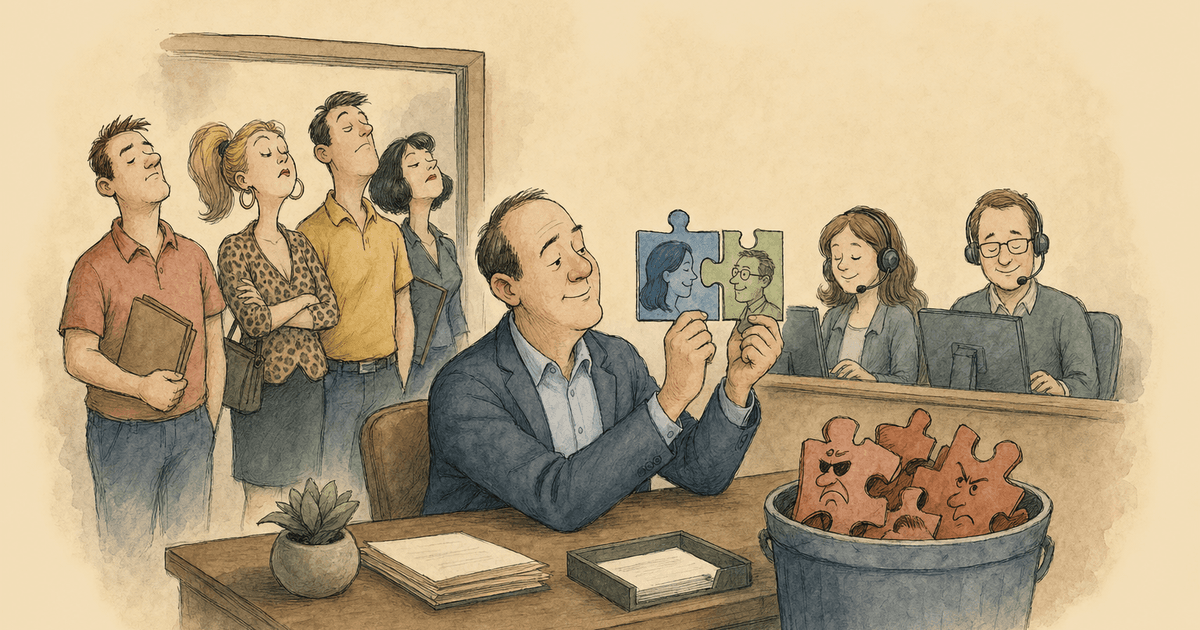
You feel the drag every Monday when the same service tickets are still open and your best CSR just gave notice. Every service chair that turns over costs you six figures in lost retention. You have been hiring for insurance experience and getting closers in service chairs.
TL;DR
Most agency owners hire service agents by resume, not by behavioral profile. A service role demands high Steadiness and high Conscientiousness on the DISC model -- the S-C combo. High-D and high-I personalities burn out in service chairs within two years because the work rewards patience and precision, not dominance and influence. Running a DISC screen before you interview cuts your service-turnover risk in half and protects the book you spent a decade building.
Why do most agency owners hire the wrong person for service?
The pattern is familiar. You post a CSR job, sift through 40 resumes, and land on the candidate with three years of insurance experience and a confident interview. They sound sharp. They seem hungry.
Six months later they are complaining the work is repetitive. Twelve months in, your top three accounts are asking to speak with you directly. Eighteen months in, they give notice and you start over.
What you hired was a high-D or high-I profile -- the same traits that make a great producer -- and dropped them into a role that demands the opposite wiring. The D profile craves challenge, control, and a visible scoreboard. The I profile runs on energy, recognition, and variety. Neither one gets any of that from processing 14 endorsement requests and answering "did my payment go through" for the fourth time before lunch.
Your gut already knows this. You have felt the difference between the service hire who lasted seven years and the one who lasted seven months. The seven-year person was steady and patient. They remembered every client's kid's name.
The seven-year person never complained about the work being boring because to them it was not boring -- it was reliable. That is the S-C profile, and you have been hiring it by accident.
What does the S-C DISC profile actually look like on the floor?
The S factor, Steadiness, is the pace-setter. High-S people seek stability, consistency, and predictable routines. They do not need the rush of a new-business close to feel productive. They get satisfaction from maintaining order and keeping promises. In a service chair, the 45-day pre-renewal checklist actually gets run -- not because someone is standing over them, but because the checklist itself is the reward.
The C factor, Conscientiousness, is the quality control. High-C people are detail-oriented, rule-following, and accuracy-driven. They notice when a certificate of insurance lists the wrong additional insured. They catch the billing discrepancy before the client sees it. They read the carrier bulletin all the way through while the producer is already on to the next quote.
Together, the S-C combo produces a service agent who treats the book like their own reputation depends on it -- because to them, it does. The steady pace keeps clients from feeling rushed. The detail orientation catches the errors that trigger E and O claims. And neither trait burns out from the work itself because the work matches the wiring.
Gallup research confirms what you have felt in your gut: matching employee strengths to the role creates extraordinary performance outcomes Gallup. The DISC model, backed by decades of validation research published by Wiley, maps these behavioral tendencies into four dimensions so you can screen for fit before you invest in a hire Wiley. And Cornell ILR research shows that better person-role fit leads directly to stronger retention -- the highest performers stay when they are in the right chair Cornell ILR.
How do you interview for the S-C profile without a formal assessment?
You can. But you should not.
A DISC assessment costs less than the first week of a bad hire's salary and takes the candidate 15 minutes. Run it before the first interview. If the profile shows high D or high I with low S and low C, you already know this person will not last in a service chair. You just saved yourself three rounds of conversations and a six-figure mistake.
But if you cannot run the assessment upfront, here is what you listen for. First, ask about their favorite part of their last job. A high-S candidate will describe the routine, the relationships, and the satisfaction of keeping things running. A high-D will describe a challenge they conquered.
Second, ask what frustrated them most. A high-C candidate will say mistakes that went unfixed and sloppy handoffs. That is exactly what you want in a service chair.
Third, ask how they organize their day. The S-C answer sounds like a system: "I start with the oldest open ticket, then check carrier downloads, then return voicemails before lunch."
Killing Commercial's Kevin Mlynarek, who built an assessment tool specifically for insurance agency hiring, put it plainly: taking a logical approach to personality fit before you hire is the difference between building a team and running a rehab clinic for bad-fit employees Killing Commercial. The assessment costs less than lunch with a carrier rep and saves you the six-figure replacement cycle on the other side.
What happens to your retention numbers when you get the profile right?
A service agent in the right behavioral chair does not leave because the work is wrong. They leave for the same reasons anyone leaves -- pay, manager quality, life changes. But they do not leave because the job is grinding against their wiring every single day. That alone cuts your voluntary turnover risk by a margin you can feel in the P and L.
Run the math. If your agency carries 1,200 households and you lose a service agent every 18 months, each departure puts roughly 600 client relationships into a handoff period. During that gap, attention drops, errors spike, and the renewal at risk goes uncaught.
A five-point retention drop from 90 to 85 percent cuts your lifetime value per household by roughly 37 percent. That is not a service problem. That is a hiring problem wearing a service mask.
Insurance agencies across the country are already struggling to fill client service roles at every level, and the talent pool gets thinner the further you get from a major metro area Insurance Journal. When you finally land a candidate, the last thing you can afford is to put them in the wrong chair. The O*NET database lists the core CSR tasks: resolving complaints, recording interactions, checking that changes were made correctly, and reviewing policy terms for coverage determinations O*NET. Every one of those tasks rewards patience and precision.
What is the math on a service-agent mis-hire?
The SHRM benchmark puts the cost of replacing an employee at 50 to 200 percent of their annual salary SHRM. We broke down the full agency-specific math in a previous post. For a service agent earning $55,000, the low end is $27,500. The high end is $110,000.
Now layer in what a vacancy does to your book. A departed service agent leaves behind open endorsements, unreviewed renewals, and client calls that go to voicemail. The producer who now has to handle service work is not out selling.
Every hour a closer spends processing a certificate of insurance is an hour they are not on the phone with a warm transfer. The math compounds fast: a producer billing at $150 per hour running service for 5 hours a week is $750 in lost production every single week the chair sits empty. Over a 12-week replacement cycle, that is $9,000 in diverted producer time on top of the direct replacement cost.
The behavioral screen that catches this before it happens costs under $100 per candidate. One avoided mis-hire pays for the assessment program for the next decade.
Sources cited in this analysis?
- SHRM -- "The Cost of a Bad Hire Can Be Astronomical" -- estimates replacing an employee costs 50 to 200 percent of annual salary (SHRM)
- Gallup -- Workplace Engagement Research -- matching strengths to role creates extraordinary performance outcomes (Gallup)
- Wiley -- "Everything DiSC Manual" -- published research on DISC methodology and workplace behavior (Wiley)
- Insurance Journal -- Magazine -- agencies struggle to fill service roles at every level (Insurance Journal)
- O*NET (DOL) -- "Customer Service Representatives 43-4051.00" -- occupational tasks for CSR roles (O*NET)
- Killing Commercial -- "Ideal Traits with Kevin Mlynarek, Episode 262" -- personality assessments for insurance agency hiring (Killing Commercial)
- Cornell ILR School -- Internal Hires Retention Study -- role fit drives retention of high performers (Cornell ILR)
Frequently Asked Questions
Can I use DISC as a hiring screen if I already run values assessments?
Yes, DISC measures behavioral tendencies -- how a person operates day to day under normal conditions. Values assessments measure what drives a person internally. Use DISC for role fit and values for culture fit. They answer different questions and both deserve a spot in your hiring stack. For more, see our breakdown of values assessments versus DISC in hiring.
What if my best service agent has a different DISC profile?
There are always exceptions. A high-C with moderate I can thrive in service if the team structure gives them enough human interaction. A high-S with low C can still excel with strong process documentation and a detail-oriented manager. The S-C combo is the highest-probability profile, not an absolute. Trust the track record over the chart.
How soon should I run the DISC assessment in the hiring process?
Before the first interview. Send the link with the interview confirmation, the candidate completes it in 15 minutes, and you review the profile before you sit down with them. The interview becomes a validation exercise instead of a discovery mission. Candidates who refuse the assessment were never going to fit the role's daily reality anyway.
Does the S-C profile work for account managers and not just CSRs?
Yes. A mid-market commercial account manager handling 40-plus policies per client needs the C factor even more than a personal-lines CSR. The detail load is heavier, the carrier relationships multiply, and the E and O exposure jumps. The S-C profile scales. For more, see our guide to DISC-based team composition.